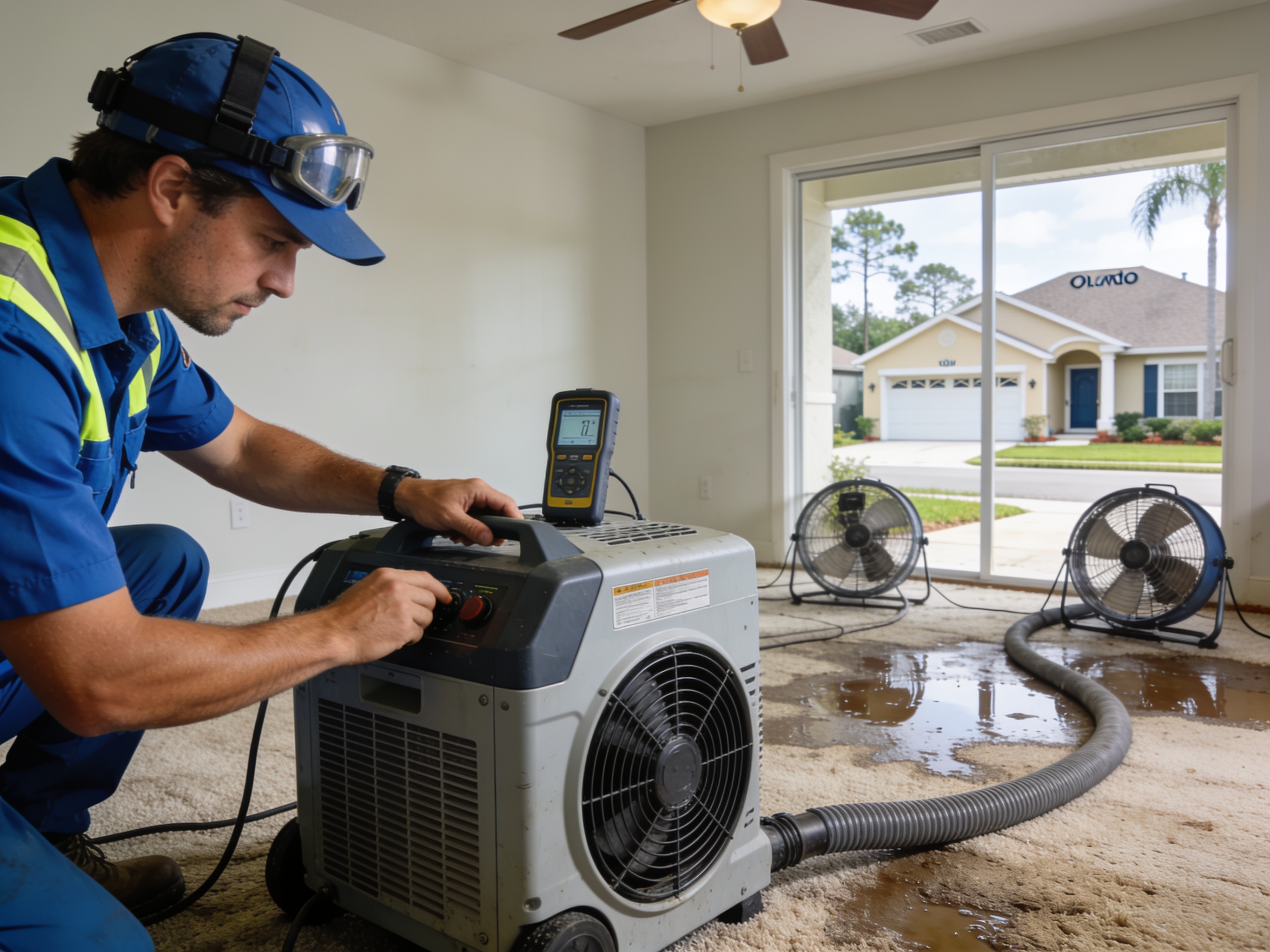
Orlando's humid subtropical climate and frequent afternoon thunderstorms keep relative humidity high year-round, which forces slower evaporation from materials like gypsum board, hardwood flooring, and concrete slabs common in College Park and Baldwin Park buildings. Without aggressive extraction and balanced airflow, moisture lingers behind baseboards and under vinyl plank, feeding mold within 48 hours. Technicians place commercial dehumidifiers rated for 150–300 pints per day and use air movers in patterns that follow the building's actual airflow rather than a grid layout.
In older Thornton Park and Ivanhoe Village structures, plaster walls and balloon framing create hidden cavities that trap water after a burst pipe. Infrared moisture mapping locates saturation that standard meters miss, then targeted drying prevents the need to open entire ceilings. Near Lake Eola Park or the Orange County Courthouse, commercial jobs often involve multiple floors and mixed-use occupancies, requiring negative air setups that protect tenants while meeting Orange County building department ventilation rules.
Winter Park and Mills 50 properties with slab-on-grade construction frequently see water wick upward into carpet padding and underlayment. Desiccant dehumidifiers are staged outside when indoor humidity exceeds 70 percent to avoid recirculating moist air. Technicians monitor daily moisture logs until readings stabilize within two percent of unaffected reference materials, documenting every step for insurance adjusters working Kissimmee and Altamonte Springs claims.
Edge cases include post-storm flooding that saturates exterior masonry in Downtown Orlando high-rises; here, wall cavity drying tubes and injected dry air prevent delamination of exterior insulation finish systems. Skipping these steps leads to recurring musty odors and failed inspections.
Technician insight
In Orlando the thing that catches most people out with Structural Drying and Dehumidification is how quickly afternoon thunderstorms push indoor humidity back above 65 percent, undoing a day's work if the dehumidifiers are undersized for the actual vapor load coming out of College Park plaster walls.
Burst pipe in Mills 50 office suite
Water migrated under vinyl plank and into the slab after a supply line failure. Infrared scans showed saturation extending ten feet beyond the visible wet area. Desiccant units ran outside while air movers dried the subfloor; three days later moisture readings matched reference areas and the tenant reopened without mold issues.
Structural Drying and Dehumidification Services We Offer
✓Moisture Mapping and Documentation
Infrared scanning and pinless meter readings create a room-by-room moisture map that guides equipment placement and satisfies commercial insurance documentation requirements.
✓Commercial Dehumidifier Placement
Strategic positioning of low-grain refrigerant and desiccant units sized for Orlando humidity loads to pull moisture from wall cavities, subfloors, and ceiling plenums without tenant disruption.
✓Air Mover and Airflow Engineering
Calculated patterns of directed airflow that follow actual building geometry in College Park and Baldwin Park structures to accelerate evaporation while preventing secondary damage to finishes.
✓Cavity and Wall Drying
Injection of dry air through base plates and drilled holes to reach hidden saturation in plaster and balloon-frame walls common in Ivanhoe Village and Mills 50 buildings.
✓Slab and Subfloor Drying
Mat systems and perimeter drying that extract moisture from concrete slabs and plywood subfloors after burst pipe events in Winter Park and Altamonte Springs commercial spaces.
Structural Drying and Dehumidification Cost in Orlando, FL
| Service | Typical Range | What Affects It |
|---|---|---|
| Single-room commercial drying setup | $800–$1,600 | Moves with square footage and equipment days needed |
| Multi-room or multi-floor drying | $2,200–$4,500 | Higher in older Thornton Park or College Park buildings with hidden cavities |
| Slab and subfloor drying add-on | $600–$1,200 | Common after burst pipe events near Winter Park |
| Daily equipment rental extension | $250–$450 | Per additional day beyond initial three-day package |
Ranges are typical for Orlando, FL and confirmed with an exact written quote before any work starts.
How it works
- 1
Initial Assessment
Technicians arrive within hours, document visible water, and run moisture scans across affected commercial spaces in Orange County.
- 2
Water Extraction
Standing water is removed first using truck-mounted and portable extractors to reduce overall load before drying begins.
- 3
Equipment Setup
Dehumidifiers and air movers are positioned according to the moisture map, with daily adjustments based on readings.
- 4
Monitoring And Completion
Daily logs track moisture until levels match unaffected areas; equipment is removed only after verification.
Pricing
Pricing depends on square footage, number of affected rooms, and whether cavity or slab drying is required.