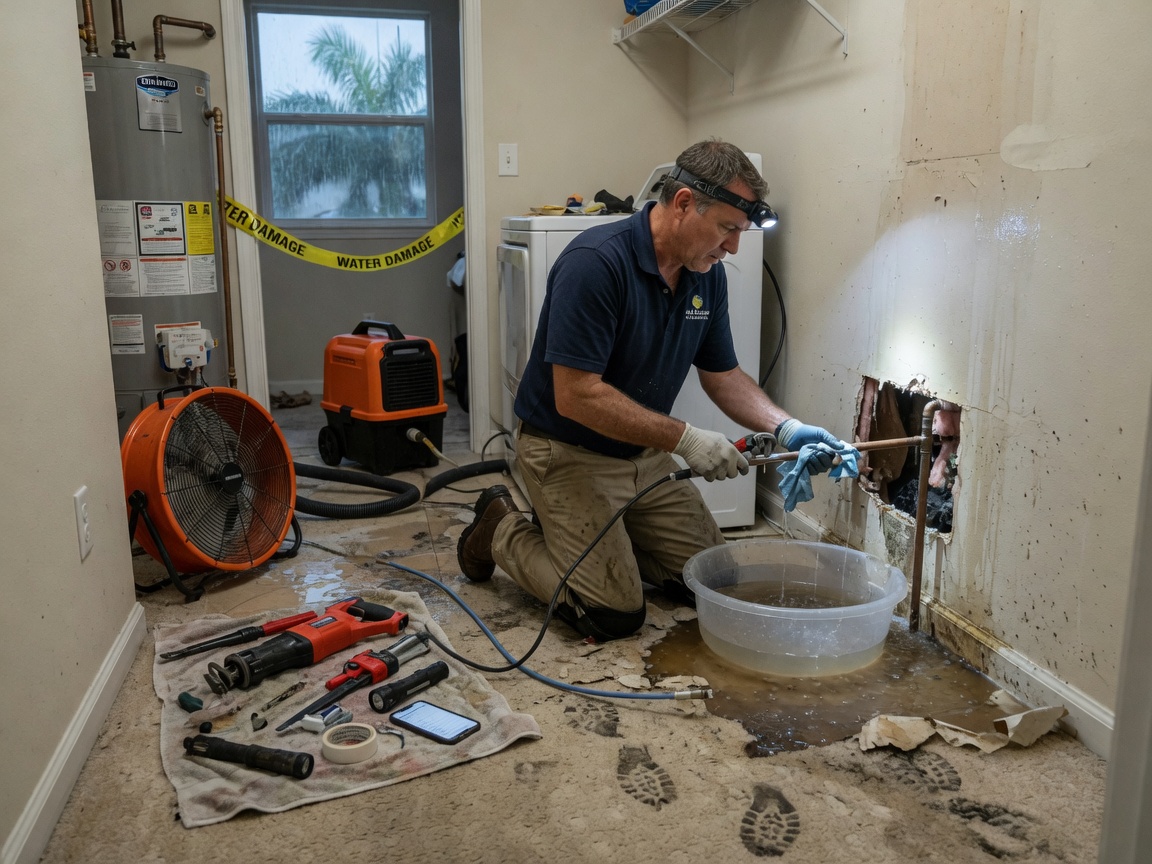
Orlando's older commercial stock in Downtown Orlando and Mills 50 often features galvanized or copper lines installed decades ago that corrode from repeated pressure spikes during afternoon thunderstorms. When a main bursts, water migrates quickly through slab foundations and into tenant spaces below, saturating carpet tiles, baseboards, and electrical runs. Crews must isolate the line, extract standing water within hours, and deploy commercial-grade dehumidifiers to prevent mold in the humid subtropical air before humidity climbs again the next afternoon.
In Thornton Park and College Park retail strips, burst pipes frequently affect shared walls and ceilings between units, requiring coordination with multiple tenants and property managers. Moisture travels along HVAC ducts and into drop ceilings, so detection with moisture meters and thermal imaging is essential to avoid hidden pockets that later trigger insurance claims. Technicians document every step for Orange County commercial code compliance while keeping businesses operational where possible.
Winter Park and Baldwin Park office buildings sit on slightly higher ground but still see rapid water spread when supply lines fail near restrooms or break rooms. The clay-heavy soils slow drainage, so subfloor drying takes longer than in sandy Kissimmee or Altamonte Springs locations. Teams stage equipment on sidewalks or loading docks to avoid disrupting foot traffic while running containment barriers and negative air machines.
Technician insight
In Orlando the thing that catches most people out with burst pipe water damage repair is how fast water travels under the slab in older Downtown and Mills 50 buildings once a line lets go during a thunderstorm; the clay soil holds moisture so long that you have to keep equipment running days longer than the same job in sandy Kissimmee soil.
Mills 50 retail space pipe failure
A supply line behind a shared wall in a Mills 50 retail building burst overnight. Water reached three tenant suites and traveled under the slab. Crews isolated the line, extracted water from all units, and ran drying equipment for five days until moisture readings cleared. Tenants reopened without further mold issues.
Burst Pipe Water Damage Repair Services We Offer
✓Commercial Burst Pipe Extraction
Rapid removal of standing water from office and retail spaces using truck-mounted pumps sized for larger square footage.
✓Emergency Pipe Leak Containment
Immediate shutoff and temporary bypass installation to stop active leaks in multi-tenant buildings without full shutdown.
✓Slab Leak Detection Orlando
Non-invasive scanning for hidden supply line failures under concrete floors common in Downtown Orlando commercial properties.
✓Post-Burst Structural Drying
Industrial air movers and dehumidifiers placed to dry walls, ceilings, and subfloors before mold sets in humid conditions.
✓Tenant Space Water Cleanup
Targeted extraction and sanitization of individual suites while protecting adjacent occupied commercial spaces.
✓Insurance Documentation Support
Detailed moisture mapping and photo logs prepared for commercial property claims in Orange County.
Burst Pipe Water Damage Repair Cost in Orlando, FL
| Service | Typical Range | What Affects It |
|---|---|---|
| Initial commercial extraction visit | $450–$900 | Depends on square footage and water depth |
| Daily drying equipment package | $250–$550 | Number of air movers and dehumidifiers required |
| Slab leak detection and mapping | $300–$600 | Thermal imaging plus moisture meter readings |
| Full job documentation for insurance | $150–$300 | Photos, readings, and summary report |
Ranges are typical for Orlando, FL and confirmed with an exact written quote before any work starts.
How it works
- 1
Immediate Response
Answer the 24/7 call, dispatch a crew, and confirm access to the commercial property within the hour.
- 2
Source Isolation
Locate and shut off the burst section, then perform a pressure test on remaining lines to prevent further damage.
- 3
Water Extraction
Remove standing water from floors and cavities using commercial equipment suited to the building's layout.
- 4
Drying and Monitoring
Set up drying zones, record daily moisture readings, and adjust equipment until readings meet commercial standards.
- 5
Final Clearance
Conduct walkthrough with property management and provide documentation for insurance and code review.
Pricing
Upfront quotes after inspection; rates reflect building size, water volume, and drying duration.