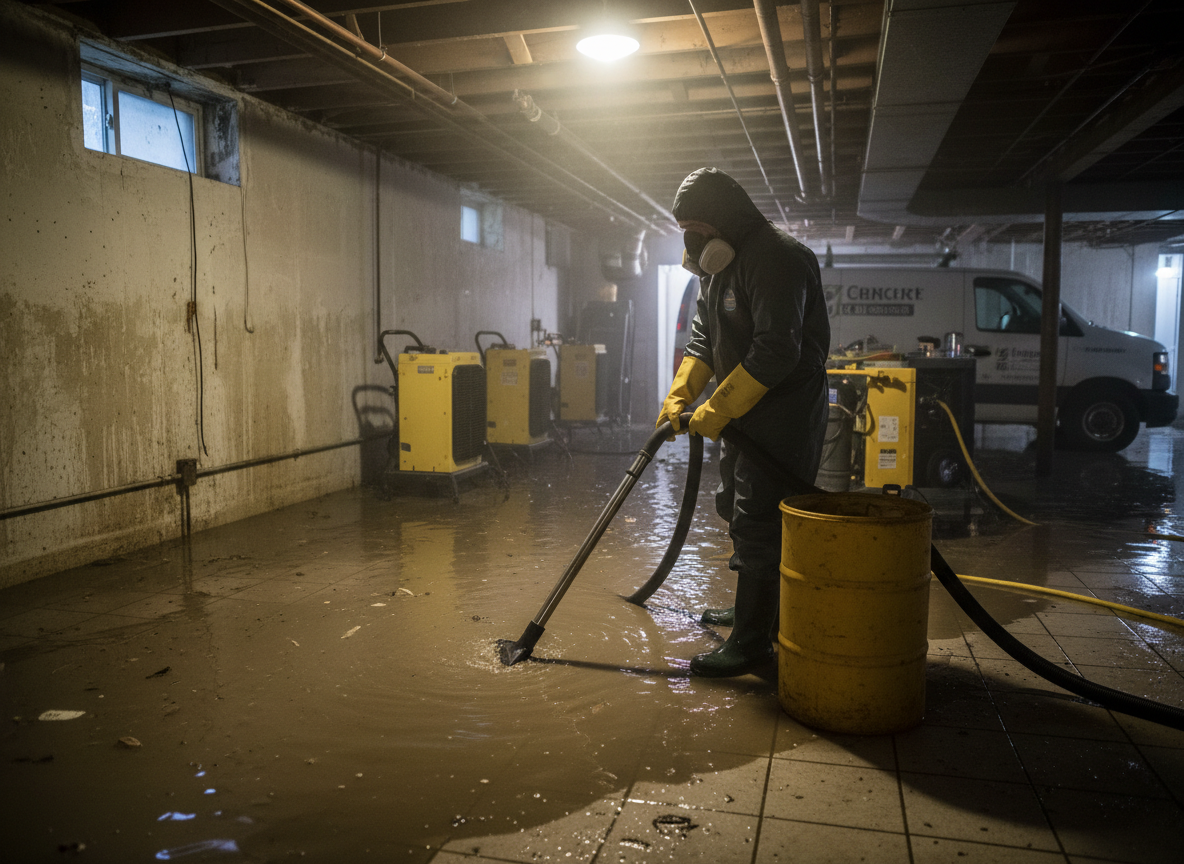
Orlando’s humid subtropical climate brings frequent afternoon thunderstorms that overload aging sewer mains, especially in neighborhoods like College Park and Mills 50 where many commercial buildings still rely on clay or cast-iron lines installed decades ago. When these lines back up, raw sewage can migrate under slab foundations and into wall cavities, creating hidden pockets that standard extraction misses. Technicians must map moisture with thermal imaging and pull baseboards to confirm migration paths before any drying begins.
Commercial spaces near Lake Eola Park and the Orange County Courthouse often sit on low-lying terrain where stormwater ponds against building perimeters. This forces sewage into HVAC return plenums and under raised flooring common in older office stock. Contaminated porous materials must be removed the same day; otherwise mold sets in within 24 hours due to high ambient humidity. All work follows Orange County health department guidelines for Category 3 water, including full PPE and negative-air containment to protect adjacent tenants.
Properties in Baldwin Park and Ivanhoe Village frequently see backups after heavy rain because their combined storm and sanitary sewers were never separated. Crews isolate the affected zone, extract standing effluent with truck-mounted units, then apply EPA-registered disinfectants to concrete and subflooring. Final clearance testing confirms no residual coliforms before tenants return. Winter Park and Altamonte Springs jobs follow the same protocol but add extra drying time because of slightly different soil drainage.
Technician insight
In Orlando, the thing that catches most people out with Sewage Backup Removal is how afternoon thunderstorms push water back through old clay lines in College Park and Mills 50 commercial buildings; once it reaches the slab, you have to open walls the same day or the humidity keeps everything wet for weeks.
Mills 50 Restaurant Backup
After a sudden thunderstorm, sewage entered the kitchen of a Mills 50 restaurant through floor drains. We found effluent had wicked into the subfloor and under the walk-in cooler. Extraction, containment, and removal of saturated plywood were completed overnight; the space reopened after clearance testing two days later.
Sewage Backup Removal Services We Offer
✓Commercial Sewage Extraction
Rapid removal of contaminated water from offices, retail, and restaurants using truck-mounted equipment sized for larger floor plates.
✓Biohazard Containment Setup
Negative-air barriers and HEPA filtration to keep sewage aerosols from reaching unaffected areas in multi-tenant buildings.
✓Storm-Related Backup Cleanup
Targeted response after afternoon thunderstorms overwhelm lines in Downtown Orlando and Thornton Park commercial corridors.
✓Slab and Subfloor Drying
Moisture mapping and drying of concrete slabs common in older Orange County commercial stock to prevent hidden mold growth.
✓Porous Material Removal
Safe disposal of saturated carpet, drywall, and insulation per local health regulations in Kissimmee and Altamonte Springs properties.
Sewage Backup Removal Cost in Orlando, FL
| Service | Typical Range | What Affects It |
|---|---|---|
| Small commercial extraction | $1,800–$3,200 | Single room or restroom backup under 500 sq ft |
| Full floor commercial cleanup | $4,500–$8,000 | Multiple rooms plus HVAC contamination |
| Slab drying add-on | $1,200–$2,500 | Per 1,000 sq ft when moisture has migrated under concrete |
| Porous material disposal | $600–$1,400 | Carpet, baseboards, and drywall removal and haul-off |
Ranges are typical for Orlando, FL and confirmed with an exact written quote before any work starts.
How it works
- 1
Site Assessment
Technician arrives within the hour, identifies sewage source, and maps affected zones with moisture meters.
- 2
Containment And Extraction
Barriers erected, standing effluent pumped out, and HVAC systems isolated to stop cross-contamination.
- 3
Disinfection And Removal
EPA-registered agents applied, then all porous contaminated materials cut out and hauled away.
- 4
Drying And Clearance
Industrial drying equipment runs until readings match unaffected areas, followed by third-party air testing.
Pricing
Cost depends on square footage affected, depth of contamination, and whether slab drying or material removal is required.